Subcontractor default is one of the most disruptive risks a general contractor can face. A trade partner can fail to perform because of financial distress, staffing problems, schedule issues, defective work, or another contractual failure. When that happens, the cost is rarely limited to the subcontract value. Replacement work, acceleration, extended overhead, delay, and project-management time can all become part of the loss.
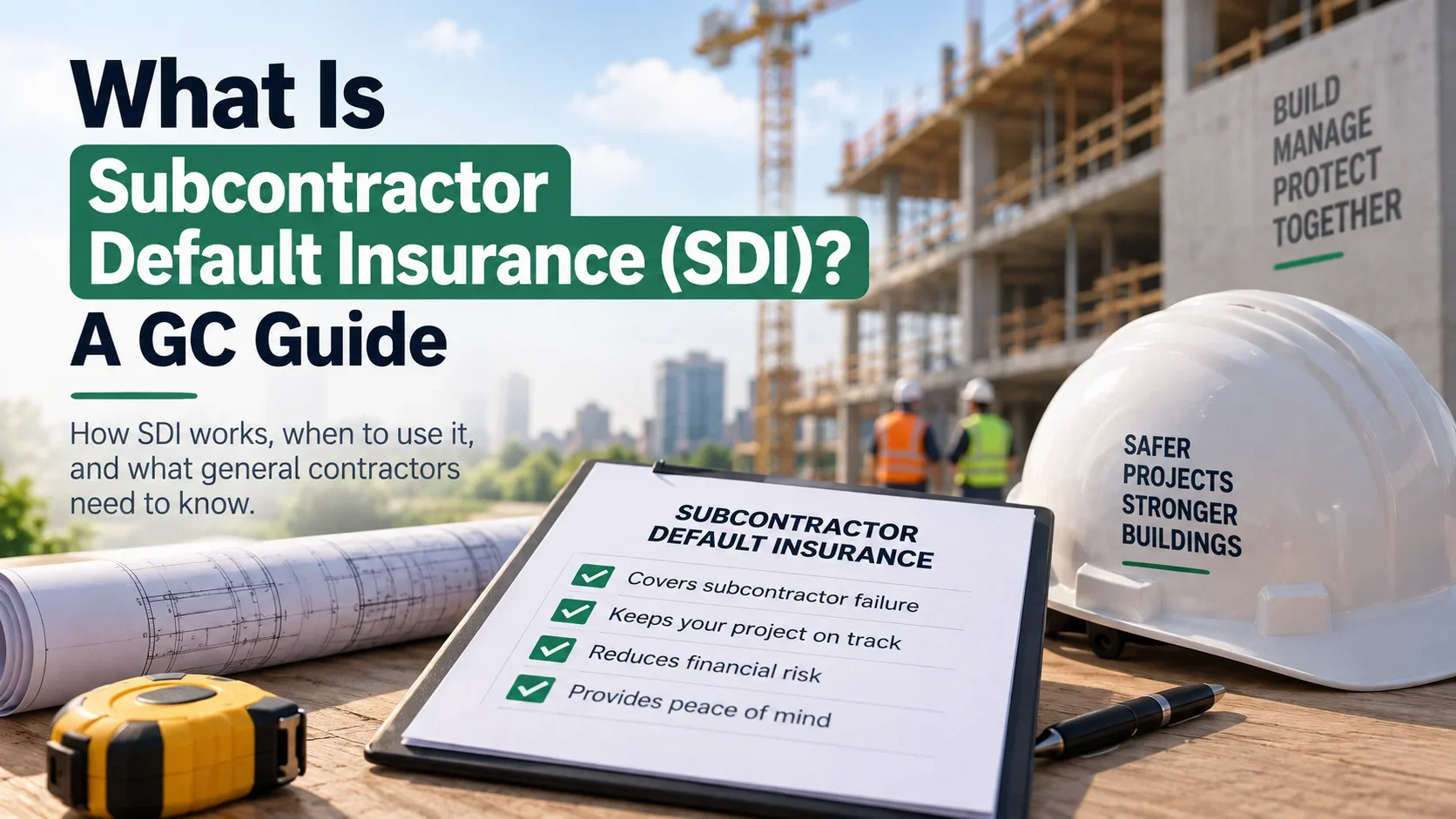
Subcontractor Default Insurance (SDI) is a specialized first-party insurance product designed to protect a general contractor from certain financial losses caused by a covered subcontractor default. Unlike a performance bond, SDI is purchased and controlled by the general contractor. AXA XL describes SDI as coverage for economic loss incurred by a GC or construction manager because of subcontractor default, while IRMI describes it as an alternative method of financing subcontractor-default risk. citehttps://axaxl.com/insurance/products/subcontractor-default-insurancehttps://www.irmi.com/term/insurance-definitions/default-insurance
This guide explains how SDI works, what makes it different from bonding, why prequalification matters, and what compliance teams should document.
What is subcontractor default insurance?
SDI is an insurance policy purchased by the general contractor to cover specified financial losses arising from the default of enrolled subcontractors. The GC is the policyholder and manages the subcontractor-selection and risk-management process.
That structure matters. The GC generally has more direct control over how a default is handled than it would under a traditional surety arrangement. Procore notes that SDI programs require the GC to vet subcontractors through a robust prequalification process. citehttps://www.procore.com/library/subcontractor-default-insurance
SDI should not be confused with general liability insurance. General liability is primarily designed around covered third-party bodily injury, property damage, and related liability exposures. SDI addresses a different risk: economic loss associated with a covered subcontractor failing to perform its contractual obligations.
How does SDI work?
A typical SDI workflow looks like this:
- The GC establishes an SDI program with an insurer.
- The GC develops qualifying criteria for subcontractors.
- Subcontractors are prequalified according to the insurer's requirements.
- Eligible subcontractors are enrolled in the program.
- If an enrolled subcontractor defaults, the GC manages the response and documents the loss.
- The GC submits a claim according to the policy requirements.
- The insurer reimburses covered losses subject to the policy's limits, retention, exclusions, and other conditions.
The exact process varies by policy. SDI programs commonly involve significant self-insured retentions, so they are not designed to eliminate every dollar of loss.
SDI vs. performance bonds
The most important comparison for a GC is usually SDI versus subcontractor performance bonding.
| Factor | SDI | Performance bond |
|---|---|---|
| Who purchases it? | General contractor | Usually subcontractor/principal |
| Who controls the program? | GC | Surety relationship controls the bond response |
| Basic purpose | Insure covered economic loss from subcontractor default | Provide a surety remedy for contractual nonperformance |
| Deductible/retention | Usually significant | Bonds generally do not operate like an insurance deductible |
| Prequalification | GC plays a major role | Surety evaluates the bonded contractor |
| Claim control | GC generally has more direct control | Surety has contractual rights and remedies |
| Best fit | Sophisticated GCs with substantial subcontract volume | Projects or contractors where bonding is required or preferred |
The choice is not purely financial. Public projects, owner requirements, contract language, and project-specific rules may require bonds regardless of whether a GC has an SDI program.
Why subcontractor prequalification matters so much
SDI shifts more risk-management responsibility toward the general contractor. That makes prequalification a core part of the program rather than an administrative side task.
A strong prequalification process may examine:
- Financial capacity
- Relevant project experience
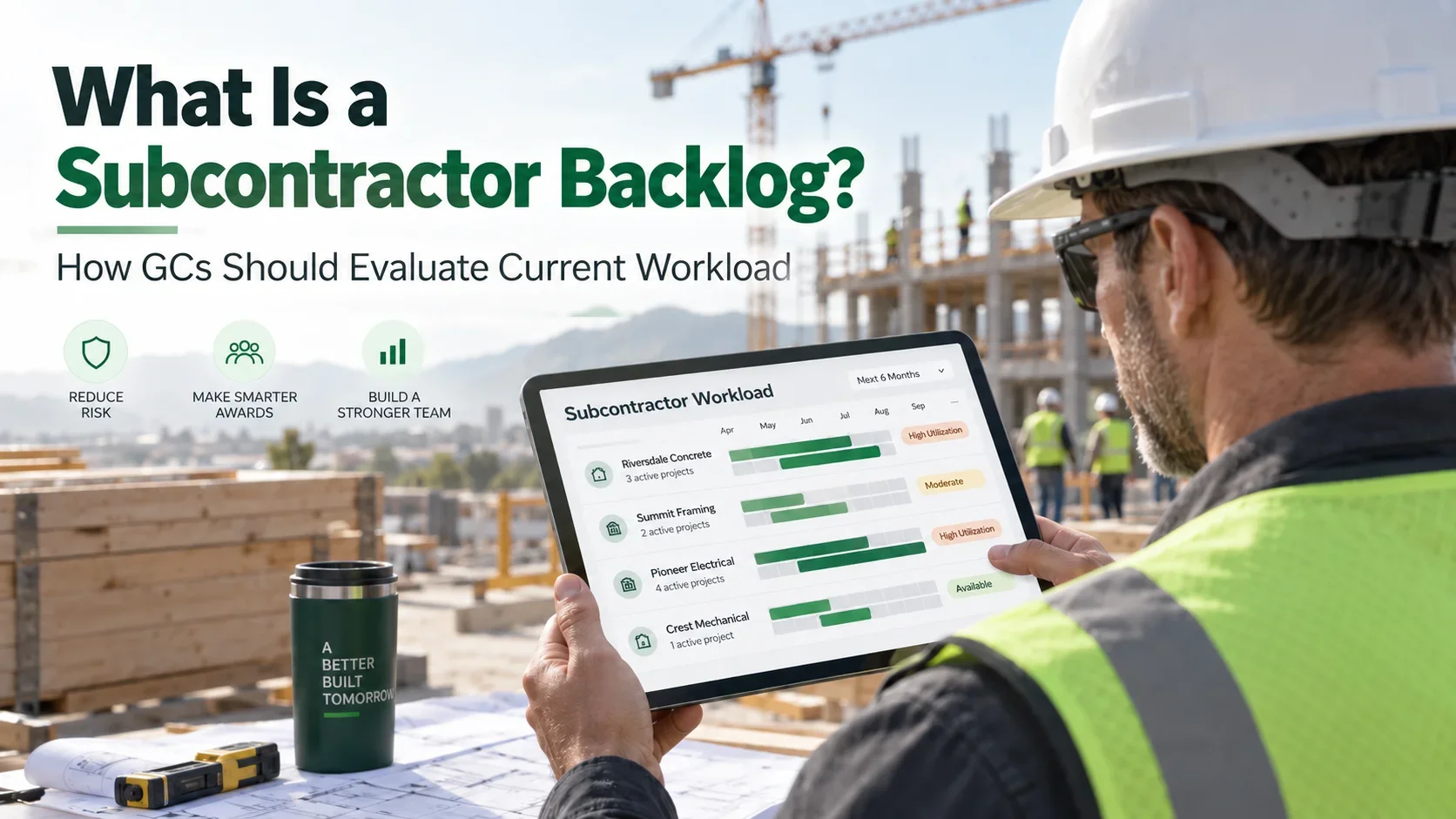
- Current backlog
- Bonding capacity where applicable
- References
- Safety history
- Claims history
- Staffing and management capacity
- Relevant licenses
- Insurance coverage
- Prior performance
- Capacity to complete the proposed scope
The exact criteria should come from the GC's program, insurer, contracts, and professional advisers. There is no universal SDI checklist that fits every contractor.
What does SDI have to do with compliance management?
A common mistake is to treat prequalification as something that happens once and then disappears.
In practice, the information supporting subcontractor risk decisions changes over time. A subcontractor may have a new financial problem, a significant backlog increase, a change in ownership, a new insurance program, or a materially different project workload.
A compliance system can help keep the evidence organized even though it does not make the underwriting decision.
For example, a GC might maintain a subcontractor record containing:
| Information | Why it matters |
|---|---|
| Legal entity | Identifies the contracting party |
| Insurance documents | Supports required coverage review |
| Licenses | Confirms applicable licensing evidence |
| Financial documents | Supports prequalification review |
| Safety records | Provides risk information |
| References | Supports performance assessment |
| Contract | Establishes obligations |
| Compliance status | Shows outstanding requirements |
| Review history | Creates an audit trail |
The objective is to make the evidence behind the subcontractor decision easy to retrieve.
What happens when a subcontractor defaults?
The policy controls the claim process, so the GC should follow its actual SDI wording rather than relying on a generic checklist.
A response may involve:
- Identifying the potential default.
- Reviewing the subcontract and applicable notice provisions.
- Documenting the subcontractor's failure to perform.
- Giving required notices or opportunities to cure when applicable.
- Measuring direct and indirect costs.
- Managing replacement or completion work.
- Preserving project records.
- Submitting the claim within the policy's required timeframes.
Documentation becomes critical. A contractor that has to reconstruct the history months later may have difficulty proving what happened, when it happened, and how the claimed costs were calculated.
What SDI does not mean
SDI does not mean a GC can stop managing subcontractor risk.
It does not automatically cover every subcontractor, every type of default, every project cost, or every contractual dispute. Coverage depends on the policy wording, enrollment, exclusions, limits, retention, claim conditions, and facts.
It also does not replace good subcontract administration. Strong contracts, accurate project records, prequalification, document management, and active project oversight remain important.
Should every GC buy SDI?
No.
SDI is generally aimed at sophisticated contractors with substantial subcontract volume and the financial and operational capacity to operate a rigorous prequalification program. Procore notes that SDI is typically associated with larger general contractors, while IRMI similarly describes it as best suited to large projects or GCs with significant subcontracted work and established risk-management processes. citehttps://www.procore.com/library/subcontractor-default-insurancehttps://www.irmi.com/term/insurance-definitions/default-insurance
For smaller contractors, other risk-transfer and subcontractor-management methods may be more appropriate.
How to prepare your compliance records for an SDI program
If your company participates in SDI, build a repeatable record for every enrolled subcontractor.
Before award
Document the prequalification decision and the information used to make it.
At contract execution
Store the executed subcontract, insurance requirements, and any SDI enrollment information together.
During the project
Monitor required documents, insurance expiration dates, material changes, and outstanding compliance issues.
If risk changes
Record the reason for the review and the action taken. Do not rely on an email thread as the only record.
If a default occurs
Preserve the contract, notices, correspondence, schedules, cost records, change orders, replacement-subcontractor information, and other evidence required by the policy and advisers.
A practical SDI readiness checklist
- [ ] SDI policy and program requirements identified
- [ ] Eligible subcontractors identified
- [ ] Prequalification criteria documented
- [ ] Financial review completed where required
- [ ] Relevant insurance reviewed
- [ ] Contract executed
- [ ] SDI enrollment confirmed
- [ ] Required licenses and documents current
- [ ] Project and subcontract records organized
- [ ] Review history retained
- [ ] Default-notice procedures understood
- [ ] Claim documentation process established
How SubCada can support the documentation side
SubCada is not an insurer, surety, or underwriting adviser. Its role is much simpler: help contractors keep subcontractor compliance information organized and visible.
For GCs that already have a sophisticated risk-management program, centralized records can reduce the administrative burden of tracking insurance certificates, licenses, required documents, expiration dates, and review status across a large subcontractor roster.
Frequently asked questions
Is SDI the same as a performance bond?
No. SDI is a first-party insurance product purchased by the GC, while a performance bond is a surety instrument with a different contractual structure and claims process.
Does SDI cover every subcontractor?
Not necessarily. Subcontractors generally must satisfy the program's eligibility and enrollment requirements, and the policy controls which losses and subcontractors are covered.
Does SDI eliminate the need for prequalification?
No. Prequalification is an important part of SDI risk management and may be required by the insurer.
Is SDI suitable for small general contractors?
It is generally designed for contractors with substantial subcontract volume and the systems and financial capacity to manage the program. Suitability depends on the contractor and policy.
Does SDI protect the subcontractor?
SDI is designed to protect the GC against covered losses from subcontractor default. It should not be treated as a substitute for insurance or payment protection benefiting the subcontractor.
Final takeaway
Subcontractor Default Insurance is a specialized risk-transfer tool for general contractors that want greater control over the financial consequences of subcontractor default. Its effectiveness depends heavily on the quality of the GC's prequalification, contract administration, project records, and compliance processes.
For contractors considering SDI, the important lesson is that insurance does not replace disciplined subcontractor management. It makes that discipline even more important.
This article is for general informational purposes and is not insurance, legal, financial, or underwriting advice. Policy terms and project requirements vary. Consult your broker, insurer, surety professional, attorney, and contract documents for project-specific decisions.