What Financial Statements Should a GC Request From a Subcontractor?
When a general contractor evaluates a subcontractor for a significant project, a current certificate of insurance and a good list of references may not be enough. The GC may also need to understand whether the subcontractor has the financial resources to support the work from mobilization through completion.
That is where financial statements and related financial information come in.
Financial review does not mean a project manager needs to become a CPA. The goal is to collect the right information, understand what each document is designed to show, identify questions that deserve follow-up, and document the decision consistently.
This guide explains what financial statements a GC may request from a subcontractor, when deeper financial review makes sense, what to look for, and how financial statements fit with WIP schedules, bonding information, and broader prequalification.
Why do GCs request subcontractor financial statements?
A subcontractor's financial position can affect its ability to fund payroll, materials, equipment, insurance, subcontractors, and other costs before progress payments are received.
A company can therefore be technically capable and still struggle if it takes on work that is too large for its financial resources or current operating capacity.
Financial statements can help a GC ask questions such as:
- Does the subcontractor have sufficient working capital?
- Is the company profitable or consistently losing money?
- Is net worth stable or deteriorating?
- Is debt increasing significantly?
- Can the company support the proposed project while completing its existing backlog?
- Does the financial information appear consistent with the company's reported size and workload?
Financial statements should be treated as one component of prequalification rather than an automatic pass/fail test.
What financial statements might a GC request?
The exact packet should be based on project size, risk, contract requirements, owner requirements, and the GC's qualification policy. A financial review may include some combination of:
| Document | What it helps show |
|---|---|
| Balance sheet | Assets, liabilities, and equity at a point in time |
| Income statement | Revenue, expenses, and profit or loss over a period |
| Cash-flow statement | Cash generated and used during the period |
| Accounts receivable aging | How quickly customers are paying and how much is outstanding |
| Accounts payable aging | Amounts owed to vendors and subcontractors and payment pressure |
| WIP schedule | Project-level work, costs, billings, and expected margins |
| Bank or credit information | Available liquidity or banking relationship, when required |
| Surety/bonding letter | Bonding limits and surety support |
Not every subcontractor needs to provide every document. The appropriate depth of review should be proportional to the exposure.
For example, a small low-risk service scope may require a lighter review than a multimillion-dollar critical-path subcontract.
Balance sheet: what should a GC understand?
The balance sheet provides a snapshot of a company's financial position at a particular date.
It generally presents assets, liabilities, and equity.
For a GC, some useful areas to understand include:
Current assets
These can include cash, accounts receivable, inventory, and other assets expected to convert to cash or be used in the short term.
Current liabilities
These can include accounts payable, short-term obligations, accrued expenses, and other amounts due in the short term.
Working capital
Working capital is commonly calculated as:
Current assets − current liabilities
Working capital can provide context about short-term financial capacity, but a single number should not be interpreted without considering the company's business model, backlog, receivables quality, and other obligations.
Debt and equity
The relationship between liabilities and equity can provide additional context about leverage and financial structure.
A GC should avoid creating a universal ratio cutoff unless its financial advisers and internal policy support that rule. Construction companies can have very different financial structures depending on trade, size, ownership, equipment requirements, and billing practices.
Income statement: what should a GC review?
An income statement shows financial performance over a period rather than at one specific date.
Reviewing it can help a GC understand:
- Revenue trend
- Gross profit
- Operating expenses
- Net income or loss
- Significant changes between periods
A subcontractor with steadily increasing revenue is not automatically financially strong. Rapid growth can require substantial working capital and management capacity.
Likewise, a single loss does not automatically mean the company is unsafe. The GC should ask what caused the loss and whether the situation is recurring.
The useful approach is to examine trends and explanations, not just one year's bottom line.
Cash-flow statement: why does it matter?
Profit and cash are not the same thing.
A company can report accounting profit while experiencing cash pressure because money is tied up in receivables, inventory, equipment, or work in progress.
A cash-flow statement can help the reviewer understand how cash moved through the business during the reporting period.
For construction companies, this can be particularly relevant because projects can require significant spending before the related cash is collected.
A GC should therefore be cautious about relying on net income alone when evaluating whether a subcontractor can support a large award.
Accounts receivable aging: what can it reveal?
An accounts receivable aging report separates outstanding customer balances by how long they have been unpaid.
For example:
| Aging bucket | Example |
|---|---|
| Current | $800,000 |
| 31–60 days | $150,000 |
| 61–90 days | $75,000 |
| 90+ days | $125,000 |
The numbers above are only an example of how the report may be structured.
A large amount of old receivables does not automatically mean a subcontractor is in financial trouble. Construction billing can involve retainage, disputed change orders, owner payment cycles, and other legitimate timing issues.
But older receivables should prompt questions, especially when the proposed subcontract is large relative to the company's available liquidity.
Accounts payable aging: what should a GC consider?
Accounts payable shows what the company owes to vendors and other creditors. Aging information can help identify whether significant obligations are becoming overdue.
For a GC, the reason this matters is operational as well as financial. A subcontractor that cannot pay material suppliers or lower-tier subcontractors may face disruptions that eventually affect the project.
Again, the purpose is not to diagnose a company from one report. It is to identify questions that deserve appropriate financial review.
How does a WIP schedule fit with financial statements?
A WIP schedule provides project-level context that the core financial statements may not show in the same detail.
For example, a balance sheet may show current assets and liabilities, while a WIP schedule can show active projects, estimated costs to complete, billings, and expected project margins.
SubCada already has a separate guide explaining this document in detail: What Is a WIP Schedule for a Subcontractor? A GC Guide.
The two should therefore be viewed as complementary rather than competing documents.
A useful financial review asks whether the WIP picture and financial statements make sense together and whether unexplained differences require follow-up.
How does bonding information fit with financial statements?
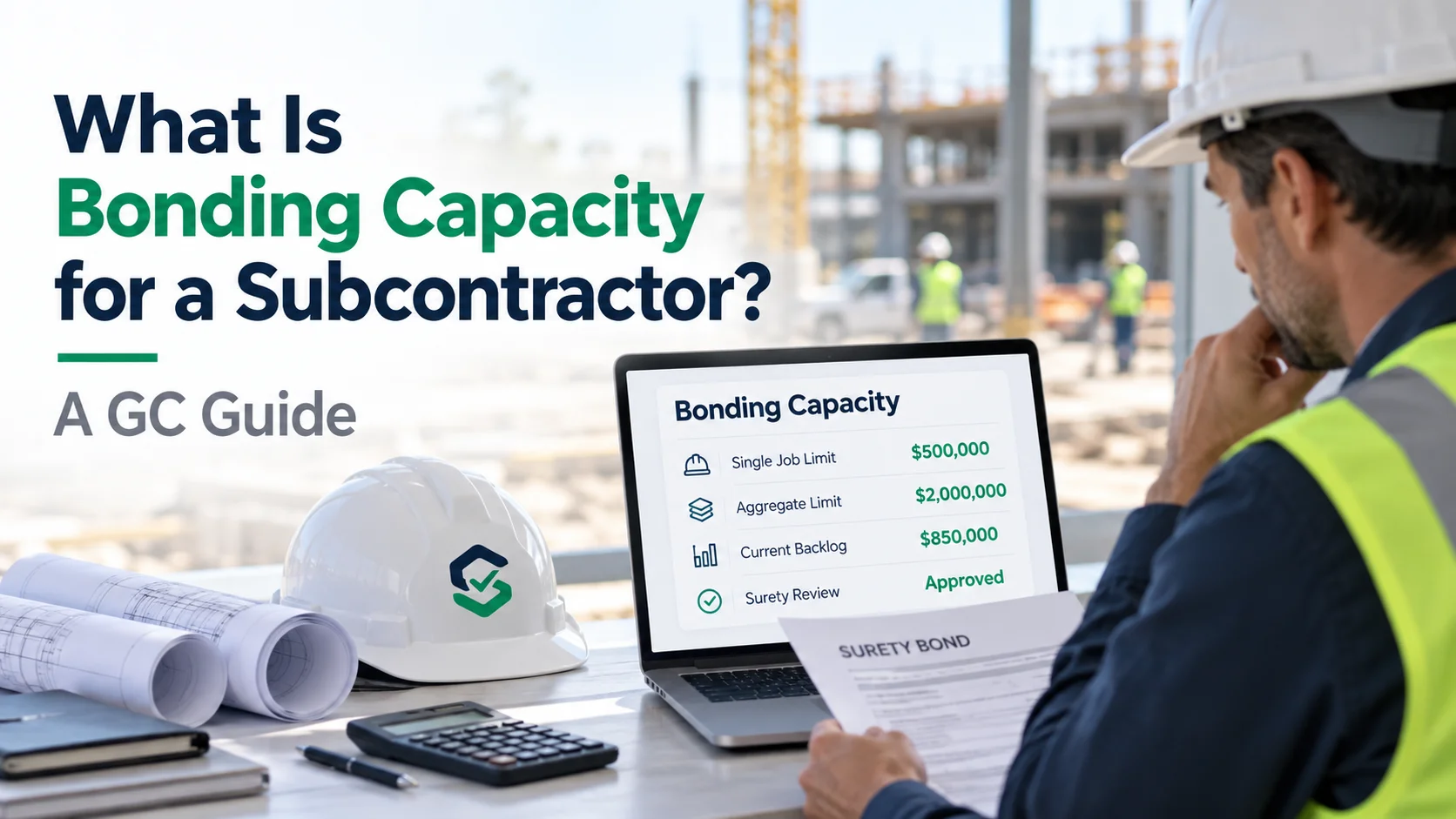
Bonding capacity is another piece of the financial-risk picture.
A surety evaluates a subcontractor's financial and operational condition before supporting its bonding program. A GC may therefore request a current surety letter showing single-project and aggregate limits when bonding is relevant.
That information should not replace financial statements. It provides another source of evidence.
A strong qualification file might therefore contain:
Financial statements + WIP schedule + bonding information + current backlog + project experience
The exact combination should match the risk and the GC's policy.
Audited vs. reviewed vs. compiled financial statements
One important question is not only what financial information you receive but how it was prepared.
In general terms:
- Audited financial statements: subject to an audit performed under applicable professional standards and provide the highest level of assurance among these three categories.
- Reviewed financial statements: subject to review procedures that provide less assurance than an audit.
- Compiled financial statements: assembled from information provided by management without the same level of verification or assurance as an audit or review.
The appropriate level depends on the project, company, owner, lender, surety, and GC policy.
The Federal Highway Administration's research on contractor prequalification provides an example of a public-agency framework where the required level of financial reporting changes based on the size of the financial rating being requested. urlFHWA contractor financial capability researchhttps://www.fhwa.dot.gov/publications/research/infrastructure/14034/003.cfm
Do not turn that example into a universal rule for private GCs. It simply illustrates why qualification programs may use different financial-document standards for different levels of exposure.
How current should financial statements be?
There is no universal age requirement for every subcontractor and every project.
However, the larger the proposed exposure, the less useful an old financial statement may become.
A practical process should record:
- Statement period
- Date issued
- Preparation level, such as audited, reviewed, or compiled
- Whether interim financial information was requested
- Reviewer
- Review date
- Exceptions or follow-up questions
Current construction prequalification procedures often request recent financial information alongside WIP, insurance, safety, and bonding documentation. For example, The Hartford's subcontractor procedure asks for multiple years of financial and WIP information as part of its qualification process. urlThe Hartford subcontractor prequalification procedurehttps://assets.thehartford.com/image/upload/bond_subcontractors_procedure_flyer.pdf
Should a GC request financial statements from every subcontractor?
Not necessarily.
A tiered approach can be more practical.
Lower exposure
For a smaller, lower-risk scope, the GC may rely on a lighter financial screen or existing qualification information.
Medium exposure
The GC may request financial statements, WIP information, and current backlog information.
Higher exposure
For a large critical-path or financially significant subcontract, the GC may require more current statements, detailed WIP reporting, surety information, bank references, or professional financial review.
The exact tiers should be defined by the organization's risk policy rather than improvised for each award.
What financial warning signs should trigger questions?
A warning sign is not automatically a reason to reject a subcontractor. It is a reason to investigate.
Potential review triggers include:
- Repeated operating losses
- Significant decline in working capital
- Rapid growth without corresponding financial resources
- Large overdue receivables
- Significant increases in short-term liabilities
- Material unexplained debt growth
- Large project losses on the WIP schedule
- Major differences between financial statements and WIP information
- Backlog that appears disproportionate to available resources
- A proposed subcontract that is unusually large compared with historical project size
The best response is to document the question and obtain appropriate professional review where necessary.
Common mistakes GCs make with subcontractor financials
Mistake 1: Collecting the PDF but not reviewing it
A financial statement stored in a folder does not create a financial review by itself.
Mistake 2: Using one ratio as an automatic pass/fail rule
Construction businesses differ. Ratios need context and should be interpreted consistently under the GC's approved process.
Mistake 3: Ignoring current workload
A subcontractor's financial statements may look strong while its current backlog creates a different capacity question.
Mistake 4: Reviewing only annual statements
If a major award is being considered months after the latest year-end statements, interim information may provide useful current context.
Mistake 5: Mixing financial review with insurance compliance
Financial capacity and insurance coverage answer different questions. They should be tracked separately even when reviewed together during prequalification.
How should GCs document the financial review?
A simple structured record can include:
| Field | Example |
|---|---|
| Statement period | FY 2025 |
| Statement type | Reviewed |
| Interim statement | Received / Not required |
| WIP schedule | Received |
| Working-capital review | Completed |
| Revenue trend | Reviewed |
| Receivables aging | Reviewed |
| Backlog | Reviewed |
| Exceptions | None / documented |
| Reviewer | Preconstruction |
| Review date | September 2026 |
| Next refresh trigger | New award above threshold |
This is easier to audit than a folder containing several PDFs with no record of what anyone actually checked.
How SubCada fits into financial-document management
SubCada does not analyze financial statements, provide accounting advice, or make underwriting decisions.
Its value is in organizing the documentation and workflow around subcontractor qualification. A GC can keep financial documents, WIP schedules, insurance records, licenses, and other qualification materials connected to the subcontractor record instead of scattering them across email and project folders.
That becomes especially useful when the same subcontractor bids on multiple projects and the team needs to retrieve the latest qualification package quickly.
Subcontractor financial review checklist
- [ ] Legal entity verified
- [ ] Appropriate financial statements requested
- [ ] Statement period recorded
- [ ] Audit/review/compilation level recorded
- [ ] Balance sheet reviewed
- [ ] Income statement reviewed
- [ ] Cash-flow information reviewed when required
- [ ] Accounts receivable aging reviewed when appropriate
- [ ] Accounts payable aging reviewed when appropriate
- [ ] WIP schedule collected when required
- [ ] Current backlog considered
- [ ] Bonding information reviewed when relevant
- [ ] Proposed subcontract size compared with company capacity
- [ ] Warning signs documented and investigated
- [ ] Reviewer and review date recorded
- [ ] Next refresh trigger established
Frequently asked questions
What financial statements should a GC request from a subcontractor?
Depending on project exposure, a GC may request a balance sheet, income statement, cash-flow statement, WIP schedule, accounts receivable aging, accounts payable aging, and supporting bonding or banking information. The exact packet should follow the GC's qualification policy and project requirements.
Do all GCs require audited financial statements?
No. Requirements vary by contractor, project, owner, contract, and exposure. Some qualification programs accept reviewed or compiled statements for certain levels of work.
Is a WIP schedule a financial statement?
No. A WIP schedule is a project-level report that complements the company's financial statements by showing information about active contracts and expected project performance.
What is the most important financial metric for a GC?
There is no single metric that works for every subcontractor. Working capital, profitability, liquidity, debt, receivables, backlog, WIP trends, and project size should be considered together.
Should financial statements be collected every year?
Many qualification programs refresh financial information periodically, but the correct frequency depends on the GC's policy and project exposure. A material new award or financial change can justify an earlier review.
Can a strong financial statement guarantee subcontractor performance?
No. Financial strength is only one part of subcontractor risk. Experience, staffing, safety, insurance, quality, project management, and current workload also matter.
Final takeaway
Financial statements help GCs look beyond a subcontractor's insurance certificate and references to understand whether the company has the financial capacity to support the proposed work.
The strongest process is not simply to collect a balance sheet. It is to review the right level of financial information for the exposure, compare it with WIP and current workload where appropriate, document the review, and establish a trigger for refreshing the information.
That turns financial documentation from a passive prequalification attachment into a useful part of the GC's risk-management record.
This article is general informational content and is not accounting, legal, financial, insurance, or underwriting advice. Financial-review requirements and interpretation vary by project, company, contract, and professional standards. Consult qualified financial and legal professionals for project-specific decisions.