
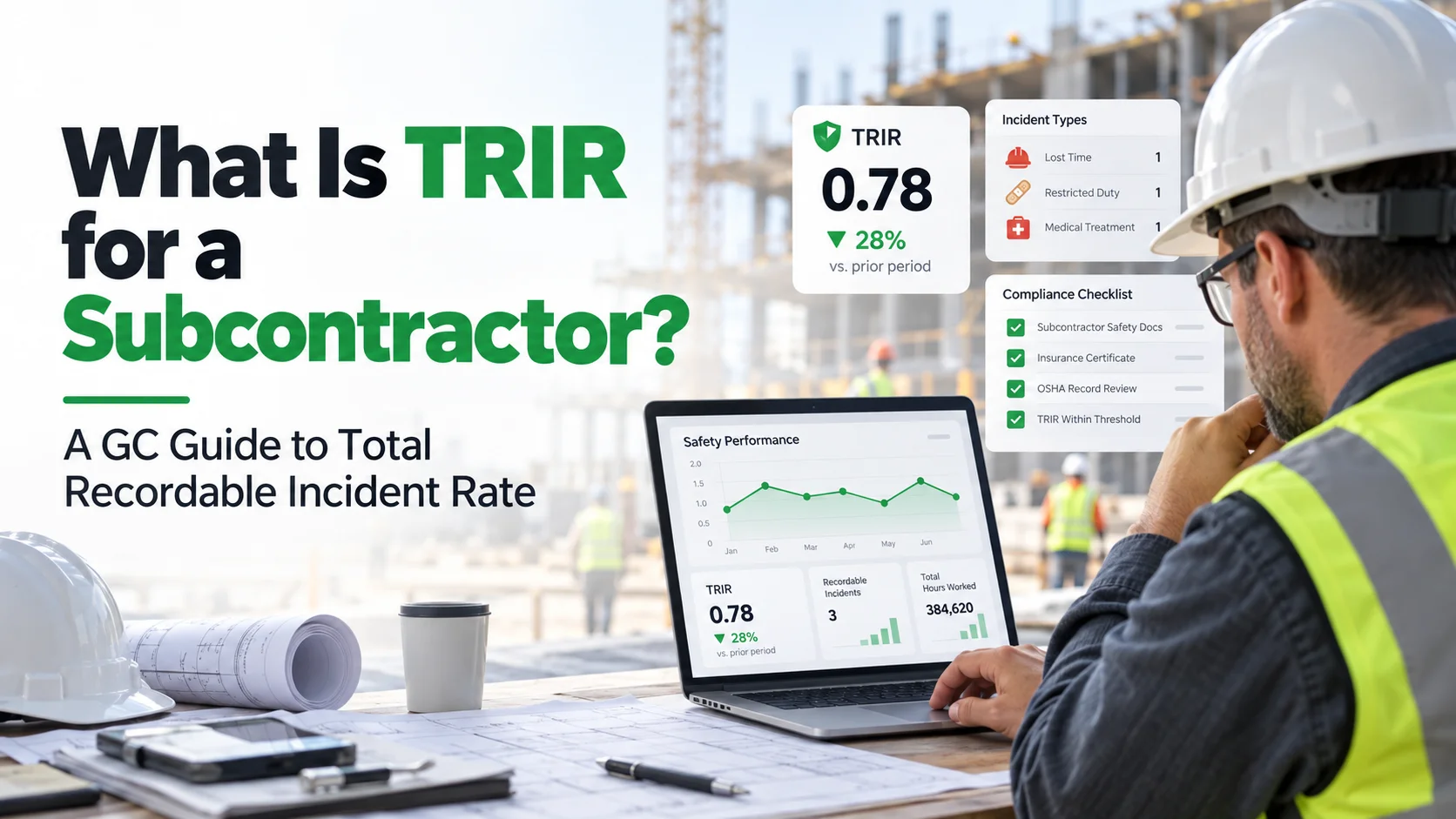
What Is TRIR for a Subcontractor? A GC Guide to Total Recordable Incident Rate
General contractors often collect safety information before approving a subcontractor. Alongside OSHA 300A summaries, Experience Modification Rates (EMR), safety manuals, and project references, one number frequently appears: TRIR, or Total Recordable Incident Rate.
TRIR can help a GC compare a subcontractor's recordable injury and illness experience across different workforce sizes. But it is easy to misuse. A single rate is not a complete safety score, a small contractor can see a large swing from one incident, and a low rate does not prove that a company has an effective safety program.
This guide explains what TRIR means, how it is calculated, what GCs should request, and how to use it as one part of a broader subcontractor safety review.
What does TRIR mean?
TRIR stands for Total Recordable Incident Rate. It is an incidence rate based on OSHA-recordable injury and illness cases and employee hours worked.
OSHA's establishment-specific injury and illness data documentation gives the general incidence-rate formula as:
(Number of injuries and illnesses × 200,000) ÷ employee hours worked = incidence rate
For the total case rate, OSHA uses the recordable cases reported in the applicable OSHA recordkeeping columns. The 200,000-hour factor represents the hours 100 full-time employees would work in a year at 40 hours per week for 50 weeks. See OSHA's Injury Tracking Application data guidance.
You may see the same concept described as TRIR, TRCR (Total Recordable Case Rate), or total case incidence rate depending on the organization or source.
Simple TRIR example
Suppose a subcontractor reports:
- 4 OSHA-recordable cases during the year
- 250,000 employee hours worked
The calculation is:
(4 × 200,000) ÷ 250,000 = 3.2
Its rate for that period would therefore be 3.2.
The number becomes meaningful only when the GC also knows the reporting period, hours worked, number of cases, type of work, company size, and appropriate comparison data.
Why do GCs ask subcontractors for TRIR?
A GC may use TRIR during prequalification to add context to a subcontractor's safety history. A standardized rate is more useful than simply comparing raw injury counts because subcontractors can have dramatically different workforce sizes.
For example, five recordable cases at a company with millions of labor hours are not equivalent to five cases at a company with a very small workforce.
A structured safety review can use TRIR to help answer questions such as:
- Has the rate moved materially over several years?
- Does the subcontractor's explanation match its OSHA records?
- Are there repeated types of incidents that deserve follow-up?
- Is recent performance materially different from older performance?
- Does the subcontractor have corrective actions for significant events?
TRIR should prompt better questions rather than automatically producing a pass/fail decision.
What should a GC request with TRIR?
A rate submitted without supporting context is difficult to review. Depending on the project and your prequalification program, consider requesting:
| Item | Why it helps |
|---|---|
| TRIR for each requested year | Shows the reported rate over time |
| Total hours worked | Lets the reviewer understand and recalculate the rate |
| Number of recordable cases | Shows what drives the numerator |
| OSHA 300A summary | Provides supporting annual safety information |
| DART rate, if used by your program | Adds context on cases involving days away, restriction, or transfer |
| EMR documentation | Adds a different workers' compensation experience measure |
| Safety program/manual | Shows processes rather than outcomes alone |
| Explanation of significant incidents | Helps reviewers understand unusual results and corrective actions |
SubCada already has detailed guides to OSHA Form 300A and subcontractor EMR. Those documents measure different things and should not be treated as interchangeable.
TRIR vs. DART rate
TRIR and DART are related but different.
TRIR generally includes all OSHA-recordable cases used in the total case rate. DART focuses on cases involving Days Away, Restricted work, or job Transfer.
OSHA's published injury data guidance states that its DART rate includes cases recorded in the relevant days-away and job-transfer/restriction categories. Because DART looks at a subset of cases, it can provide another view of severity and work impact.
A GC should label each metric clearly in its prequalification system instead of storing a generic field called “safety rate.”
TRIR vs. EMR
TRIR and EMR are often collected together, but they are not the same measurement.
TRIR is built from OSHA-recordable cases and hours worked for a reporting period. EMR is a workers' compensation experience-rating measure that compares loss experience with expected losses under the applicable rating system.
A subcontractor could therefore have a TRIR trend that looks different from its EMR trend. Differences are not automatically errors because the metrics use different inputs and methodologies.
For a deeper explanation, see What Is an EMR for a Subcontractor?.
How should a GC review subcontractor TRIR?
1. Confirm the reporting period
Make sure everyone is talking about the same calendar year or multi-year period. Do not compare a partial-year number with a full-year number without understanding the difference.
2. Collect the inputs, not just the rate
Ask for total recordable cases and hours worked. This allows the reviewer to identify simple data-entry or calculation problems.
3. Look at multiple years when appropriate
One year can be noisy, particularly for smaller subcontractors. A multi-year view can reveal whether an unusual year is isolated or part of a pattern.
4. Use an appropriate benchmark carefully
If your organization compares a subcontractor's rate with industry data, use a relevant industry classification and period. Do not compare unlike trades or assume one national number is a universal qualification threshold.
The U.S. Bureau of Labor Statistics publishes occupational injury and illness incidence-rate data that can provide industry context. The correct comparison depends on classification and period.
5. Investigate material changes
If a rate changes sharply, ask why. The answer may involve a serious event, changes in reporting, rapid workforce growth, acquisitions, changes in operations, or other factors.
6. Review corrective actions
A useful safety review is forward-looking as well as historical. Ask what the subcontractor changed after significant incidents and whether those actions are documented.
7. Document the decision
Record what was reviewed, who reviewed it, when the review occurred, and any exception or follow-up requirement. This is especially important when multiple project teams prequalify the same trade partner.
Why small subcontractors can have volatile TRIRs
Because the formula uses employee hours in the denominator, one recordable case can have a large mathematical effect when a company has relatively few hours worked.
Imagine two contractors each record one case. The contractor with 40,000 hours worked will calculate a much higher rate than a contractor with 400,000 hours worked.
That does not mean the incident should be ignored. It means the rate needs context. A rigid cutoff can create misleading results if the reviewer never looks behind the number.
OSHA itself cautions against concluding that establishments are the “most dangerous” or “least dangerous” solely from injury-rate data and notes limitations in submitted data. That is a useful principle for subcontractor prequalification as well.
Common TRIR review mistakes
Treating TRIR as a complete safety score
TRIR describes recorded outcomes. It does not directly measure training quality, field supervision, hazard planning, near-miss reporting, subcontractor management, or safety culture.
Comparing different periods
A 2025 annual rate and a 2026 year-to-date rate are not automatically comparable.
Ignoring hours worked
Without hours, a reviewer cannot understand the denominator or easily validate the calculation.
Using the same threshold for every trade
Construction trades have different exposure profiles. Qualification criteria should be set intentionally with safety and risk professionals rather than copied from another company's form.
Rejecting a contractor based on one number without review
A rate may justify follow-up, but the decision should reflect your company's documented prequalification process, project requirements, and professional guidance.
A practical TRIR review checklist
Before marking a safety review complete, confirm:
- [ ] Reporting year is identified
- [ ] Total recordable cases are provided
- [ ] Employee hours worked are provided
- [ ] Rate calculation is consistent with the submitted inputs
- [ ] OSHA 300A or other required supporting record is on file
- [ ] DART is recorded separately if required
- [ ] EMR documentation is tracked separately
- [ ] Multi-year trend has been reviewed where appropriate
- [ ] Significant changes or incidents have notes
- [ ] Exceptions and approvals are documented
- [ ] Next review date is clear
How TRIR fits into subcontractor prequalification
TRIR is most useful when connected to the rest of the qualification record. A GC may also review licensing, insurance, OSHA records, EMR, financial capacity, bonding, references, backlog, and relevant project experience.
See SubCada's subcontractor prequalification checklist for the broader framework.
The operational challenge is keeping those records connected. A safety rate might be reviewed annually while a COI expires midyear and a license follows another renewal cycle. When each item lives in a separate spreadsheet or email chain, teams lose visibility into what is current.
Managing safety qualification records with SubCada
SubCada helps general contractors organize subcontractor requirements, documents, expiration dates, and follow-up in one compliance workflow. Rather than treating TRIR as an isolated spreadsheet cell, a team can keep the supporting safety documentation alongside the subcontractor's broader qualification record.
The goal is not to let software decide whether a subcontractor is “safe.” The goal is to give the people responsible for qualification a clearer, more consistent record of what was requested, received, reviewed, and still needs attention.
Frequently asked questions
What is a good TRIR for a subcontractor?
There is no universal TRIR that makes every subcontractor acceptable. Appropriate comparisons depend on industry classification, period, workforce size, project requirements, and the GC's documented safety program. Use relevant benchmark data and professional safety judgment rather than a universal internet cutoff.
Is TRIR the same as OSHA 300A?
No. OSHA 300A is an annual summary form. TRIR is a calculated incidence rate that uses recordable cases and hours worked.
Is TRIR the same as EMR?
No. TRIR is based on OSHA recordable cases and labor hours. EMR is a workers' compensation experience-rating measure.
Should GCs collect several years of TRIR?
Many prequalification programs review multiple years because trends can provide more context than a single year. The appropriate period is an internal risk-management decision and may vary by project.
Bottom line
TRIR gives GCs a standardized way to put a subcontractor's recordable cases in the context of hours worked. It is useful, but only when the underlying data, period, company size, trends, and other safety information are considered.
A strong process does three things: collect the supporting information, review the number in context, and document the decision.