
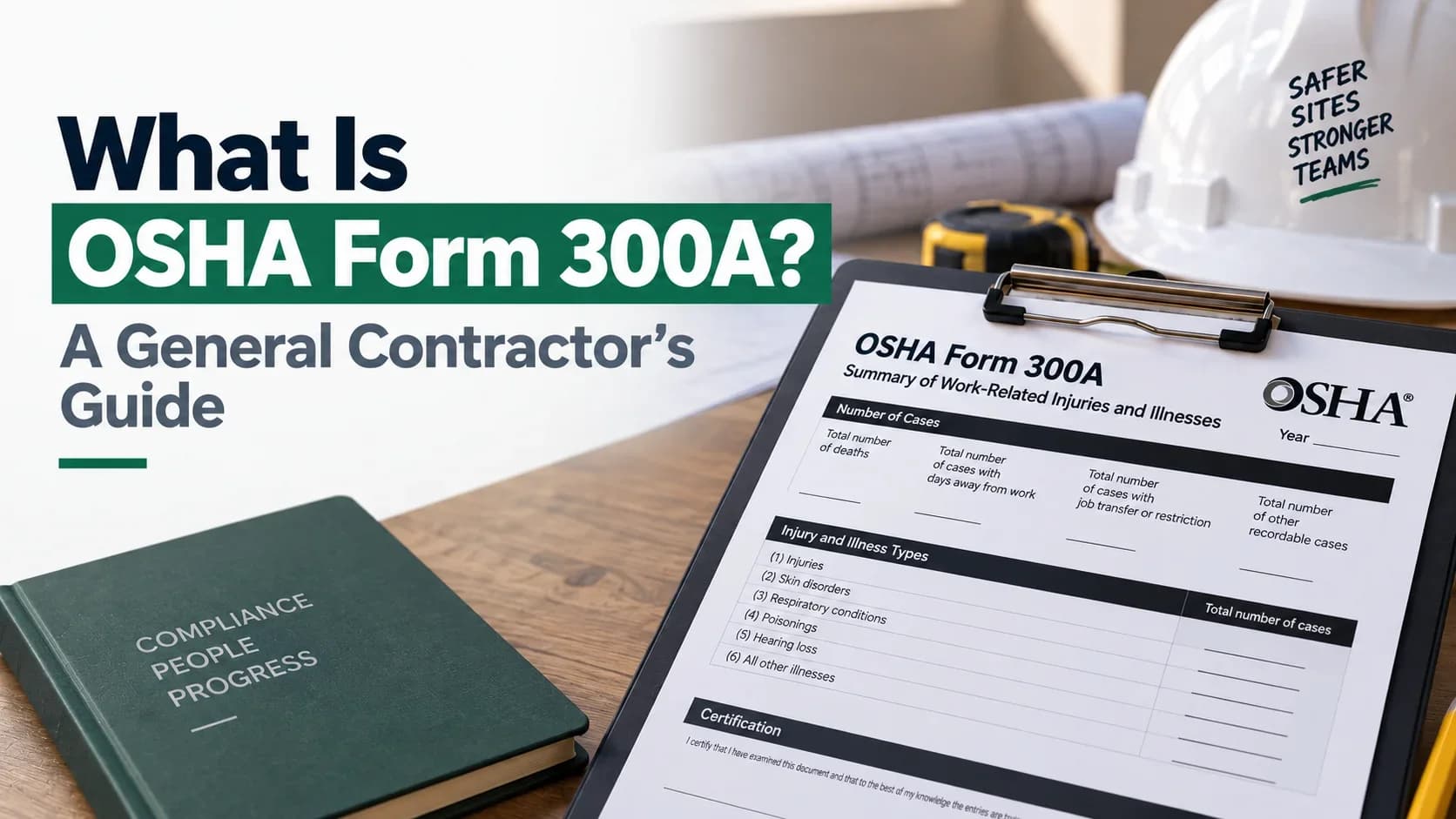
General contractors often ask subcontractors for OSHA injury and illness records during prequalification. One document that appears frequently is OSHA Form 300A, the annual Summary of Work-Related Injuries and Illnesses.
But what exactly does the form show? Does every subcontractor have to provide it? Can a GC use it as proof that a subcontractor has a good safety program? And how should a construction company keep the information organized?
This guide explains the role of OSHA Form 300A in subcontractor qualification and compliance workflows, while separating the form itself from the broader safety responsibilities that apply to a construction employer.
What is OSHA Form 300A?
OSHA Form 300A is an annual summary of certain work-related injuries and illnesses recorded by an establishment on its OSHA 300 Log during the applicable reporting period.
The form summarizes injury and illness information rather than listing individual employee names. OSHA's recordkeeping rules determine which employers and establishments are covered and what information must be recorded.
For GCs, the important point is that a 300A is a summary record. It should not be treated as a complete description of a subcontractor's safety program or every safety issue that could affect a project.
Why do GCs request OSHA 300A forms from subcontractors?
Some general contractors and owners use OSHA records as part of subcontractor prequalification or safety review.
For example, current GC prequalification programs request multiple years of OSHA 300A records. DPR's subcontractor requirements currently request OSHA 300A forms for the last three years and, when applicable, OSHA 300 logs with employee names omitted. urlDPR subcontractor prequalification requirementshttps://cmicr12web.dpr.com/cmicprod/PmSsPrequal/SaveSSPrequalP6.do?navPage=6&saveDraft=Y
Other GCs may use different requirements. The request should therefore be tied to the company's written qualification policy, owner requirements, contract, project, or safety program.
What information is on Form 300A?
The form summarizes recordable injury and illness data for an establishment. Depending on the applicable form and reporting year, it can include totals such as:
- Total number of cases
- Cases involving days away from work
- Cases involving job transfer or restriction
- Other recordable cases
- Total number of days associated with cases
- Injury and illness types
- Total hours worked
- Average number of employees
These numbers can be used to calculate or understand safety metrics such as the Total Recordable Incident Rate (TRIR), but the form should be interpreted in context.
OSHA 300 vs. OSHA 300A vs. OSHA 301
The three forms serve different functions.
| Form | Basic purpose |
|---|---|
| OSHA 300 | Log of recordable work-related injuries and illnesses |
| OSHA 300A | Annual summary of the OSHA 300 Log |
| OSHA 301 | Injury and illness incident report or equivalent record |
A GC should not assume that receiving a 300A means the underlying 300 Log or incident information has been reviewed. If the project or qualification process requires additional records, request them separately.
Does every subcontractor have to complete Form 300A?
No universal rule says that every subcontractor must provide a 300A to every GC.
OSHA recordkeeping requirements contain exemptions and special rules based on factors such as employer size and industry classification. Electronic reporting requirements can also apply differently depending on the employer and establishment.
A GC should not create its own blanket statement that every subcontractor is legally required to have the same OSHA records.
Instead, define what your company requires for qualification and ask subcontractors for the applicable documentation.
For questions about whether an employer is covered by OSHA recordkeeping requirements, use OSHA's current guidance rather than relying on a generic checklist. urlOSHA Recordkeeping and Reporting Requirementshttps://www.osha.gov/recordkeeping
What should a GC check when reviewing a 300A?
1. Correct company and establishment
Confirm that the document belongs to the subcontractor being evaluated and understand whether the record represents one establishment or multiple locations under the applicable reporting rules.
2. Reporting year
Record the year covered by the form. Do not file multiple years together without identifying them individually.
3. Completeness
Check whether the form appears complete and signed or certified where required by the applicable process.
4. Injury and illness totals
Review the reported cases and days. Large changes from one year to another may deserve a question, but they should not be interpreted without context.
5. Hours worked and employee count
These figures provide context for incident-rate calculations. A small change in the number of cases can have a very different effect for a company with 20 employees versus one with 500.
6. Related safety information
Use the 300A alongside the other safety documents required by the GC's qualification program rather than treating it as a standalone safety score.
Can a GC use OSHA 300A to calculate TRIR?
The 300A contains information that can be used to calculate recordable incident rates when the necessary figures are available.
A commonly used formula for Total Recordable Incident Rate is:
TRIR = (Number of recordable cases × 200,000) ÷ total hours worked
The 200,000-hour base represents the approximate hours worked by 100 full-time employees working 40 hours per week for 50 weeks.
A GC should verify that the case count and hours worked come from the appropriate reporting period and that the calculation is being applied correctly.
Do not treat a calculated TRIR as an official OSHA score or a universal pass/fail threshold.
What else should a GC review besides the 300A?
A strong subcontractor safety review can include:
- OSHA 300A records when applicable
- OSHA 300 Logs when required by the qualification process
- OSHA citation history
- Written safety program
- Training records
- EMR documentation
- Recent incident information
- Corrective-action records
- Trade-specific safety credentials
- Project-specific safety plans
- Competent-person qualifications where applicable
The appropriate list depends on the work, hazards, project requirements, jurisdiction, and GC policy.
Common mistakes when collecting OSHA 300A records
Mistake 1: Asking for the form without specifying the years
A request such as “send your OSHA records” creates unnecessary back-and-forth. State exactly which years are required.
Mistake 2: Treating the 300A as a complete safety assessment
The form summarizes recordkeeping information. It does not tell the GC everything about field supervision, training, hazard controls, or current project conditions.
Mistake 3: Ignoring establishment differences
The records may relate to specific establishments. Understand what the document represents before comparing one company with another.
Mistake 4: Mixing safety requirements with insurance requirements
OSHA records, EMR information, COIs, endorsements, and licenses serve different purposes. Keep them as separate compliance requirements even when they are reviewed during the same prequalification process.
Mistake 5: Losing the review history
A file containing the document but no record of who reviewed it can still create an audit problem. Capture the reviewer, date, status, and any follow-up questions.
How should GCs handle missing 300A records?
First determine why the record is missing.
Possible situations include:
- The subcontractor is not subject to the applicable recordkeeping requirement.
- The requested year predates the company's operations.
- The company changed its legal structure.
- The GC requested a record that does not apply to the subcontractor's establishment.
- The subcontractor has not yet supplied the document.
Each situation should have a documented resolution rather than an unexplained “missing” label.
For example:
Status: Exception documented — subcontractor provided written explanation that the requested record does not apply to the entity under the applicable OSHA recordkeeping rules. Reviewed by safety/compliance team.
The exact determination should be made by the appropriate qualified person.
How often should GCs collect 300A records?
The answer depends on the GC's qualification program and the subcontractor's applicable reporting requirements.
Many organizations refresh qualification information annually or when a subcontractor is being considered for a new project. Some projects or owners can require more specific records.
The important operational step is to define a refresh rule instead of relying on memory.
OSHA 300A review checklist for GCs
- [ ] Correct subcontractor legal entity confirmed
- [ ] Applicable establishment identified
- [ ] Reporting year recorded
- [ ] Form reviewed for completeness
- [ ] Case totals reviewed
- [ ] Hours worked and employee count reviewed
- [ ] TRIR calculated if required
- [ ] OSHA citation history checked when required
- [ ] Related safety documents reviewed
- [ ] Exceptions documented
- [ ] Reviewer and review date recorded
- [ ] Next refresh requirement recorded
How to organize OSHA records across your subcontractor network
Safety documents can quickly become difficult to manage when every project team stores them differently. One project may keep 300A files in a shared drive, another may have them in an email thread, and a third may store them inside a prequalification platform.
A centralized subcontractor compliance record makes it easier to connect safety documents with the subcontractor, project requirements, qualification status, and review history.
SubCada can help general contractors organize compliance documents and track the status of subcontractor requirements alongside other records such as insurance, licenses, and tax documents.
The goal is not to replace a qualified safety professional. It is to make sure the administrative side of document collection and follow-up does not disappear into disconnected folders.
Frequently asked questions
Is OSHA 300A the same as OSHA 300?
No. OSHA 300 is the log of recordable cases, while 300A is the annual summary of the log.
Do all subcontractors have to provide OSHA 300A to GCs?
No. GC requests vary, and OSHA recordkeeping rules include exemptions and special requirements. The GC should define its qualification requirements and ask for applicable records.
Can OSHA 300A be used to calculate TRIR?
Yes, the form contains information that can be used for the calculation when the required figures are available. The calculation should be checked for accuracy and interpreted in context.
Is a low TRIR proof that a subcontractor is safe?
No. Incident rates are one data point. A broader safety review should consider training, supervision, programs, citations, incidents, and project-specific hazards.
How many years of OSHA 300A should a GC request?
There is no universal number for every project. Many qualification programs request multiple years, but the GC should follow its written policy and project requirements.
Can a GC keep OSHA records indefinitely?
Retention should follow the company's document-retention policy and applicable legal or contractual requirements. Sensitive safety records should be handled appropriately.
Final takeaway
OSHA Form 300A can be a valuable document in subcontractor qualification because it provides a standardized annual summary of recordable injury and illness information. But it is only one part of a responsible safety review.
For GCs, the best workflow is to define which safety records are required, request the correct reporting years, verify the subcontractor and establishment, record the review, document exceptions, and keep the information connected to the subcontractor's compliance record.
That makes the process easier to repeat across projects and easier to explain when someone asks why a subcontractor was approved.
This article is general informational content and is not legal, OSHA, safety, or compliance advice. OSHA requirements and project qualification requirements can vary; consult OSHA guidance and qualified professionals for project-specific questions.